Reliable mid-grade wood pellets for everyday residential and commercial heating.
ENplus® A2 wood pellets sit within the ENplus® certification scheme at a slightly wider tolerance than A1, offering dependable heating performance at a more accessible price point. This line is co-branded with our Austrian milling partner, Theurl Holz & Ausing GmbH, and supplied under the KASUWOOD OÜ label. Suited to residential and commercial boilers designed for A2-grade fuel.
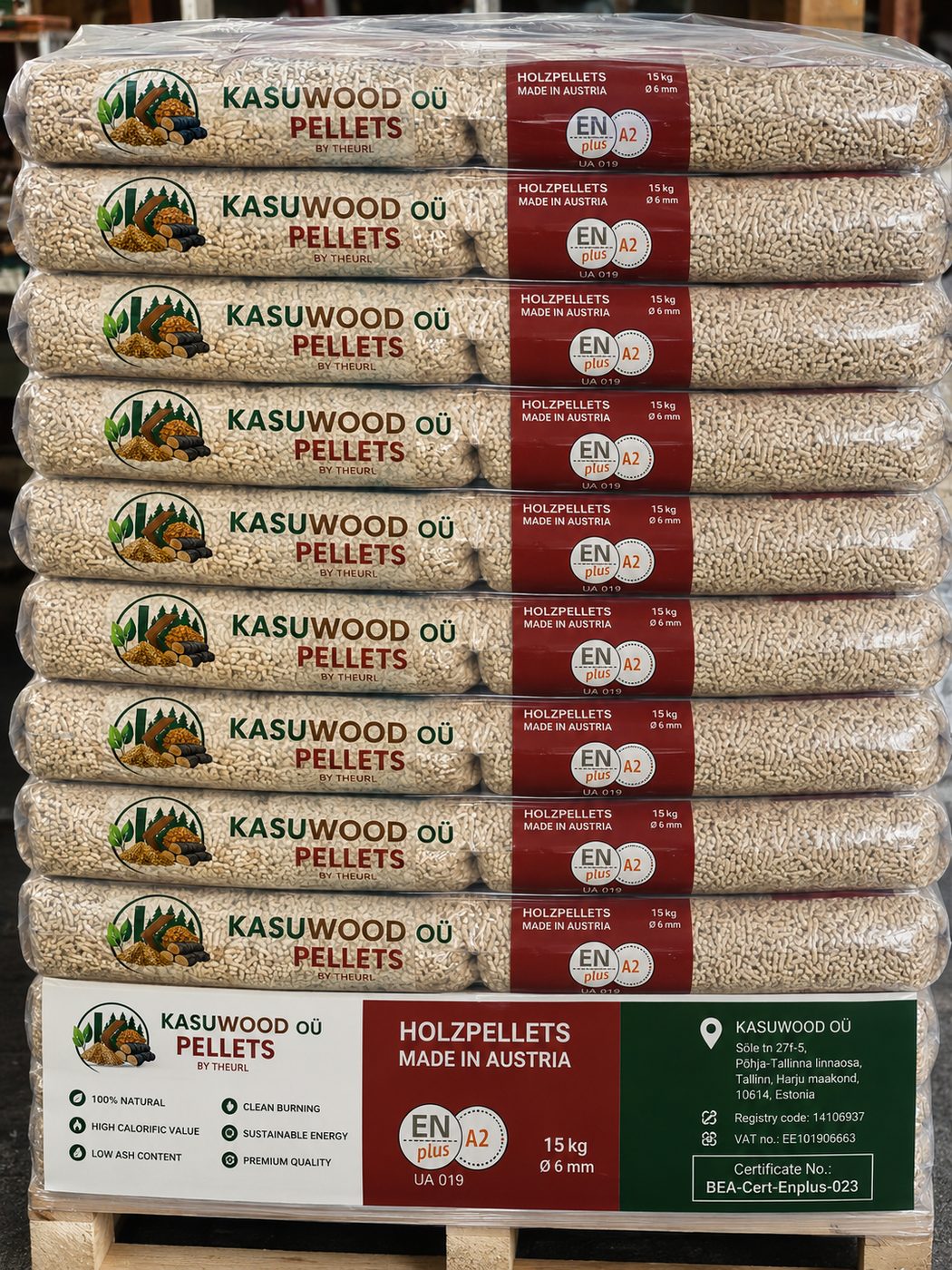
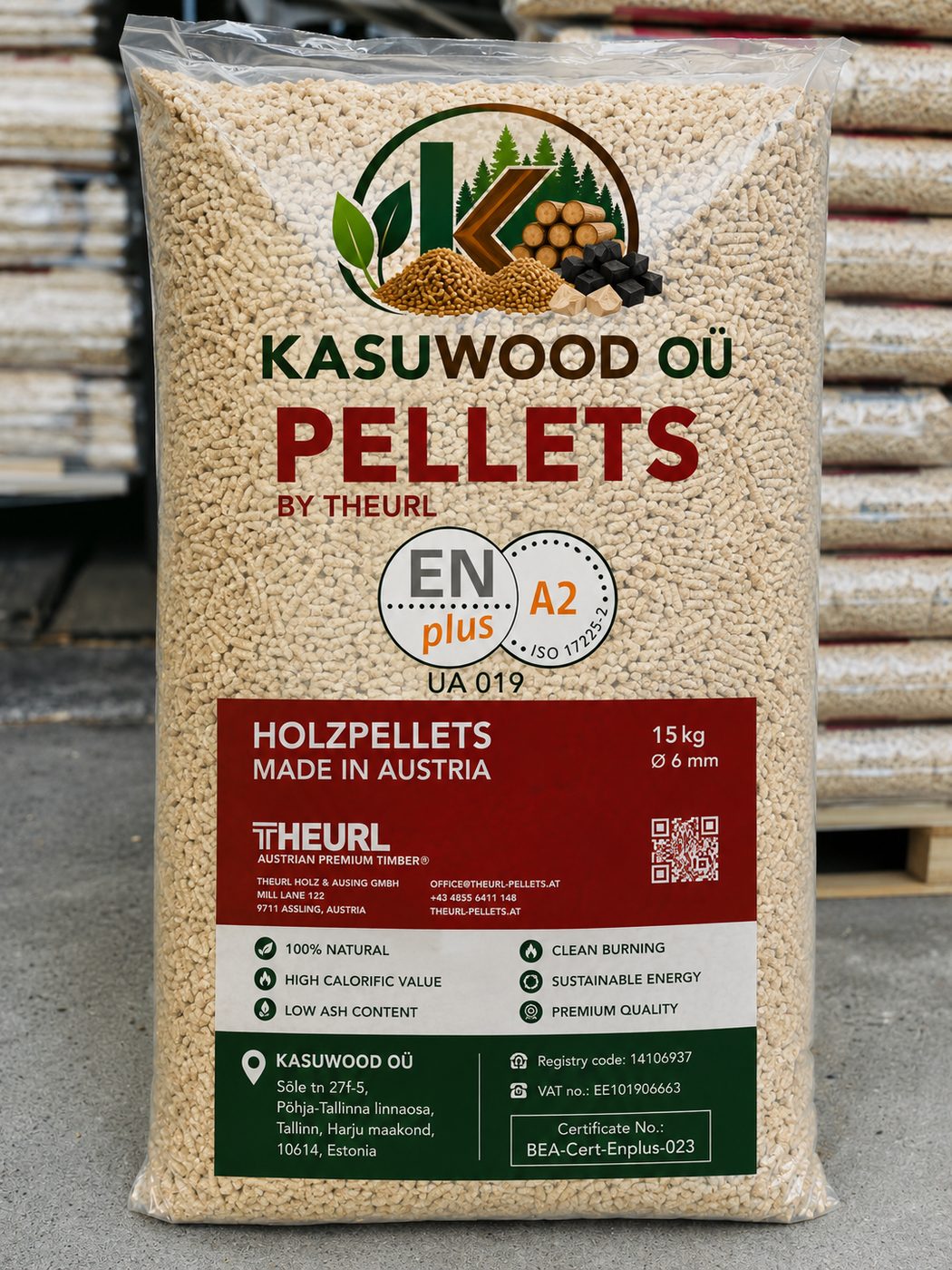

Packaging options are subject to product availability and customer requirements.
Wood pellets are a compressed biomass fuel made by processing dried, ground wood — typically sawmill by-product such as sawdust and shavings — under high pressure, with no added binders or chemicals. The natural lignin in the wood softens under heat and pressure and binds the pellet together as it cools. Because they are dense and dry, wood pellets burn more efficiently and produce a more consistent, controllable heat output than raw firewood, which is why they are the standard fuel for automated pellet boilers and stoves across Europe.
KASUWOOD OÜ sources and coordinates wood pellet supply from Estonia to commercial buyers across the EU, working with both our own production lines and established milling partners. For wholesalers, distributors and heating companies, that means one contact for sourcing, documentation and logistics, rather than juggling separate mills, freight forwarders and customs paperwork per country.
Two figures matter most when comparing wood pellets: moisture content and ash content. Lower moisture means more of the wood's energy goes into heat rather than evaporating water, giving a higher net calorific value. Lower ash content means less residue to clean out of a boiler or stove, and generally indicates a cleaner raw material with less bark content. Diameter (6 mm or 8 mm) should match what your boiler or stove is designed to feed — check your appliance manual before ordering a diameter you haven't used before.
Residential heating distributors buy wood pellets for resale to homeowners running automated pellet boilers and stoves — for this channel, consistent bag weight, clean packaging and a certification buyers recognize (ENplus® A1 or A2) matter more than price alone, since the end customer is choosing a fuel for their own home. Commercial and light-industrial heating operators — small hotels, apartment blocks, agricultural buildings — typically buy larger volumes on a recurring basis and care most about consistent moisture and ash content batch to batch, since variation affects boiler maintenance schedules. Wholesalers and import/export traders buy to resell across borders, and need a supplier who can produce commercial documentation, confirm certification status clearly, and hit agreed delivery windows reliably. Retailers stocking pellets alongside other heating fuels want a supply partner who can also cover firewood, briquettes or charcoal from the same account, reducing the number of supplier relationships they need to manage.
Wood pellets vs. firewood vs. wood briquettes. All three are wood-based heating fuels, but they suit different equipment and different buyers. Wood pellets are the most energy-dense per unit of storage volume and are the only option that works in automated auger-fed boilers and stoves, which is why they dominate the residential and light-commercial heating market where appliances are designed around them. Firewood is generally the lowest cost per delivered tonne and remains the standard for open fireplaces and manually loaded stoves, but it takes up significantly more storage space for the same heat output and needs manual loading. Wood briquettes sit between the two: denser and longer-burning than firewood, but — unlike pellets — loaded by hand into a stove or fireplace rather than fed automatically. For a distributor deciding what to stock, the deciding factor is usually what appliances your customer base already has installed, since switching fuel type often means switching heating equipment too.
How to choose the right wood pellet grade. Start with what your end customer's appliance is rated for — this is usually printed in the boiler or stove manual, and using a lower grade than specified can affect warranty cover in some cases. If you're stocking for a market where customers actively look for a recognized certification mark, ENplus® A1 is the safer default even at a higher cost, since it's the most widely recognized standard across the EU. If your buyers are price-sensitive and their appliances tolerate wider tolerances, ENplus® A2 offers a lower landed cost while remaining a certified, quality-controlled product. For industrial or bulk buyers running boilers not designed around residential certification schemes, our Standard/Industrial line — supplied with disclosed moisture, ash and calorific value — is usually the most cost-effective fit. When in doubt, tell us your appliance type and typical order volume, and we'll recommend the grade that fits.
Wood pellets are generally classed as a renewable heating fuel because they're produced from sawmill by-products — sawdust and shavings that would otherwise go to waste — rather than wood harvested specifically for fuel. Because the carbon released during combustion is broadly balanced by the carbon absorbed as trees grow, biomass fuel is widely treated as significantly lower-carbon than fossil heating fuels over its full cycle, provided the source timber comes from responsibly managed forestry. Buyers sourcing for markets with renewable-energy incentive schemes should confirm the specific documentation their local scheme requires, as requirements vary by country.
A1 has the strictest limits on ash and moisture and is aimed at residential boilers and stoves. A2 allows slightly wider tolerances at a more accessible price, and is still suitable for most residential and commercial appliances rated for A2 fuel. Industrial-grade pellets are typically supplied in bulk for power plants and district heating, where certification to a residential standard is less relevant than consistent bulk volume.
Wood pellets should be kept dry and off the ground, ideally in a dedicated pellet store, silo, or the original sealed packaging until use. Pellets that absorb moisture will swell, break apart, and lose calorific value, so damp basements or uncovered outdoor storage should be avoided.
Consumption depends on your building's heat demand, insulation, and boiler efficiency, but as a starting point, most residential heating systems in Europe use somewhere in the range of 2–5 tonnes of wood pellets per heating season for an average household. Commercial and industrial volumes are calculated per boiler specification — send us your boiler's rated output and we can help size the order.
It's best not to. Mixing diameters can cause feed jams in auger-fed systems, and mixing certification grades makes it harder to predict ash output and burn quality. Stick to one grade and diameter per appliance unless your manufacturer specifies otherwise.
Requirements vary by country and by whether the end use qualifies for a renewable-heating subsidy scheme — some national schemes require ENplus or an equivalent certification for the fuel to qualify. Check your local scheme's requirements; we can confirm certification documentation for any batch you order.
Pellets exposed to moisture absorb water, swell, and physically break apart into sawdust — at that point they can no longer be used in an auger-fed system and have lost most of their value. This is why our deliveries use weatherproof packaging and covered transport, and why we recommend covered, off-ground storage on your end.
Many multi-fuel stoves can burn wood pellets, but not all are designed for it — pellets burn differently to logs or coal, with a different air-flow requirement. Check your stove's manual, or ask us and we can help you understand what's typically compatible.
Kept dry and sealed, wood pellets have a long shelf life — commonly a year or more without meaningful quality loss. The limiting factor is almost always moisture exposure rather than age, so storage conditions matter more than how long ago the pellets were produced.
Once you send your required quantity and delivery destination, our sales desk confirms availability and issues a wholesale quotation. Typical EU truck delivery runs approximately 3–5 business days after payment confirmation and loading — see our full delivery process for details.
A side-by-side look at the three main wood pellet grades — who each one is built for, and how to decide between them.
Read ArticleA practical guide to matching wood pellet grade, diameter and certification to your heating appliance and budget.
Read ArticleWhat changes when you move from occasional orders to a recurring bulk supply relationship — and what to ask your supplier upfront.
Read ArticleTop-grade wood pellets for residential and small commercial heating.
View ProductBulk biomass pellets for industrial heating and process-energy applications.
View ProductENplus® A1 wood pellets in a 1000kg FIBC bulk bag, for buyers who want certified quality without repackaging into smaller units.
View ProductSend your required quantity and delivery destination and our sales desk will prepare a wholesale quotation.